16S/18S/ITS Amplicon Sequencing
We study the composition of bacterial and archaeal (16S) or eukaryotic (18S/ITS) community profiles
Specialised service
Taxonomic profiling and microbiota diversity analysis
The aim is to analyse the taxonomic profile and diversity of the bacteria, archaea, or fungi present in a sample.
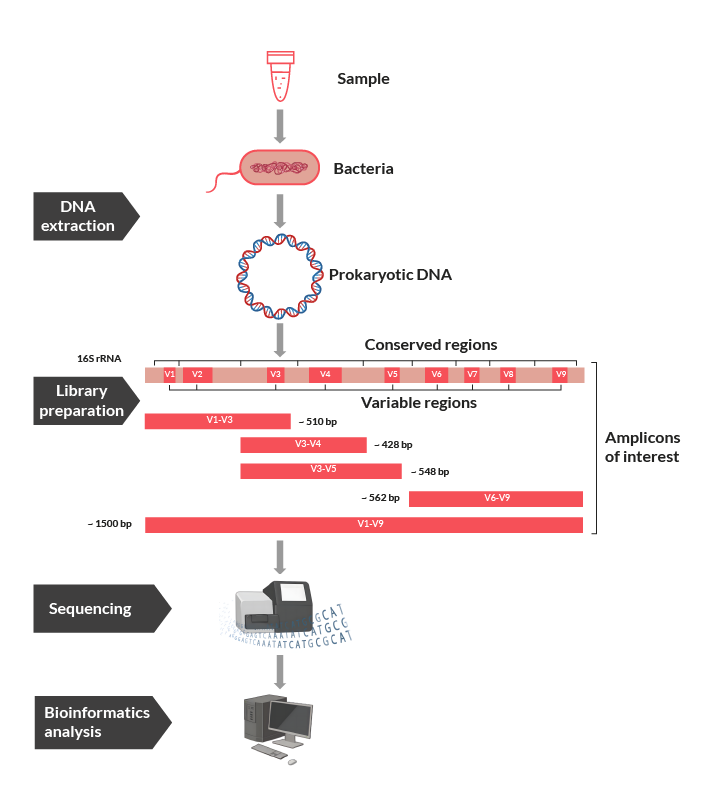
16S rRNA is a gene exclusively found in prokaryotes, mitochondria, and chloroplasts. Its highly conserved nucleotide sequence contains nine interspersed hypervariable regions, with the V3-V4 regions being the most extensively studied. These regions are distinctive sequences for each phylogenetic group and therefore serve as markers. By amplifying and sequencing these regions, the microbiota composition of a sample can be determined by comparing it with reference databases.
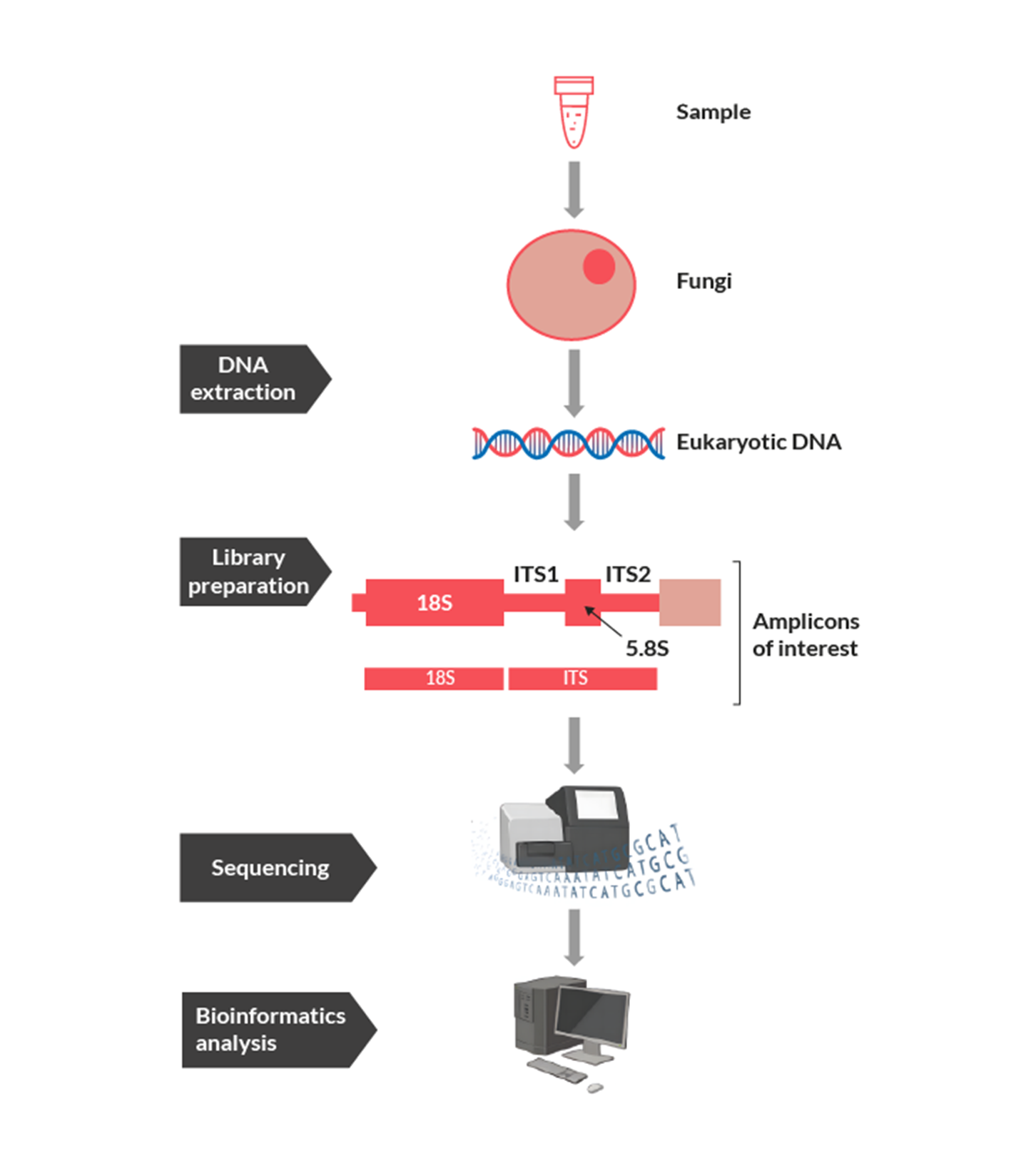
In the case of fungi, which are eukaryotic organisms, the regions most commonly used for amplicon sequencing are the 18S rRNA gene and the ITS region by following the same principle: unique sequences for each phylogenetic group. The Internal Transcribed Spacer (ITS) consists of two non-coding DNA sequences located between the ribosomal subunit genes of most eukaryotic species.
The choice of marker to be amplified in amplicon sequencing studies depends on the fraction of the metagenome being investigated as well as the sample type since some regions are more suited than others to the annotation of specific taxa. This decision should be addressed during the study design phase.
What does our service include?
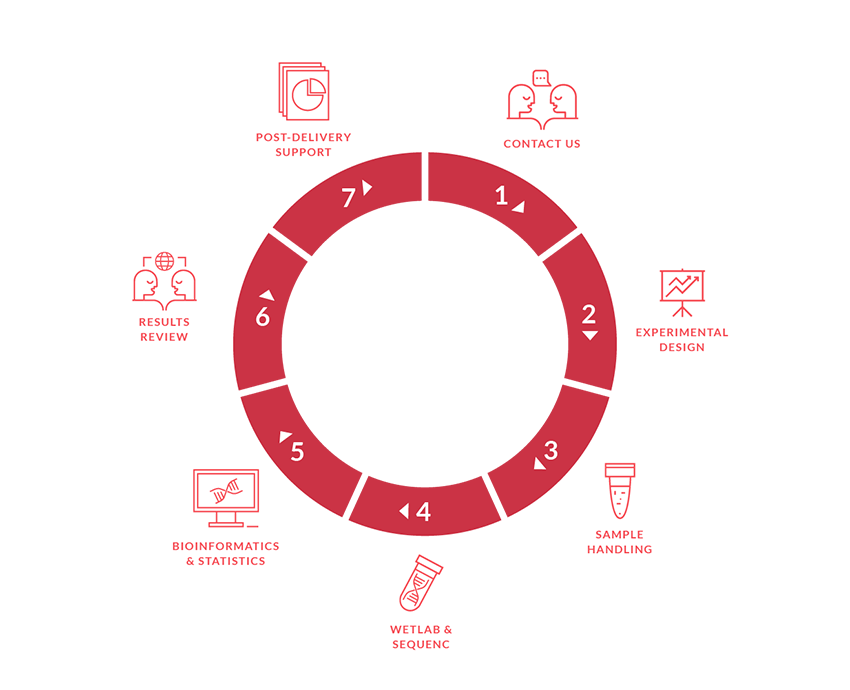
Scientific and technical consultancy
- Experimental design
- Analysis strategy
- Sampling protocol
- Sample logistics solutions
- Biobanking and sample storage until analysis
DNA extraction, library preparation, and sequencing
- Laboratory with certified clean-room facilities
- Use of positive and negative controls
- Selection of specific markers and purification protocols according to sample type
Tailored bioinformatics analysis
- Quality filtering and validation based on historical analytical data
- Alpha and beta diversity analysis, with ASV-based taxonomic profiling
- Prokaryotic functional inference and statistical analysis using specialised models and validated proprietary pipelines
- Two hours of post-delivery consultation included with every full study
Results delivery meeting
- Interactive reports featuring dynamic graphs and tables. Materials and methods documentation
- Downloadable publication-ready figures
More information
View the service datasheets.
Frequently Asked Questions About Our Amplicon Sequencing Service
What types of studies use amplicon sequencing?
16S amplicon sequencing for prokaryotes is used in microbiota analysis across a wide range of sectors (and 18S/ITS for eukaryotes and fungi).
- Health: gut, oral, skin and vaginal microbiome
- Agriculture: soil, rhizosphere and biocontrol
- Environment: water, air and bioremediation
- Veterinary medicine, animal production and food: safety and hygiene
It enables the characterisation of the microbial community present in a sample and facilitates comparisons between batches, treatments, time points, management practices, and others, making it ideal for both research projects and industrial quality control. The study design and monitoring strategy depends on the project objectives and may include observational, treatment-control, and longitudinal or intervention studies.
What types of samples can be analysed?
We work with a wide variety of sample types and have extraction and purification protocols for more than 50 different matrices, including several low-biomass sample types. Each sample type presents its own challenges such as contaminants or inhibitors, which must be addressed appropriately to obtain high-quality DNA for library preparation.
Some examples of sample types include: human samples (faeces, saliva, nasopharyngeal and oropharyngeal swabs, skin and mucosal samples, tape strips), veterinary samples (faeces, biopsies, swabs, and urine), environmental and agricultural samples (soil, rhizosphere and root samples, filtered freshwater and seawater, sediments and filtered air), surface and biofilm samples, and food ingredients and products.
Biological samples should be collected, transported, and stored according to the downstream analyses to be performed. Different sampling options are available, including the use of bacteriostatic agents to minimise sampling bias.
We also offer optimisation services for novel sample types.
What information can be obtained from microbiota analysis using amplicon sequencing?
16S amplicon sequencing (and 18S/ITS for eukaryotes and fungi) provides a taxonomic profile of the microbial community, including relative abundances for each sample and study group.
The analysis includes alpha and beta diversity metrics, comparisons between experimental conditions, and identification of differential taxa that may serve as potential biomarkers. Taxonomic resolution is usually at the genus level (at species level when supported by the region/database, e.g. SILVA or UNITE). Detection limits depend on the sample type and sequencing depth.
How will I receive the results?
Throughout the process, you will be supported by a Project Manager who will keep you informed of your project’s status. Once the analysis has been completed, you will receive a PDF guide together with login credentials to access and download the results from the Microomics server. You will receive the raw sequencing data, a report detailing the materials and methods used in the project, and an HTML report that allows you to explore the results using dynamic tables and graphs as well as download figures and perform comparisons between analytical models.
How long does the analysis take?
Project turnaround times vary considerably depending on the stages carried out by Microomics (DNA extraction, library preparation, sequencing, and bioinformatics analysis) as well as the number and type of samples analysed. Delivery times typically range from 4 to 12 weeks for amplicon sequencing studies. We recommend contacting our team for a more accurate estimate.
What is the difference between amplicon sequencing and shotgun metagenomics?
16S/18S/ITS amplicon sequencing uses PCR amplification of a marker gene to generate taxonomic profiles with relative abundance data. It is faster and more cost-effective but provides lower taxonomic resolution, generally at the genus level.
Shotgun metagenomics sequences all DNA present in a sample without targeted PCR amplification, enabling species- and strain-level identification, functional analysis of genes, and recovery of metagenome-assembled genomes (MAGs). It requires greater sequencing depth, bioinformatics processing and budget.
In summary, amplicon sequencing is best suited for efficient comparative microbiome characterisation focused on taxonomy, whereas shotgun metagenomics is better when maximum taxonomic resolution and functional information are required. We recommend discussing your project objectives with the Microomics team to determine the most appropriate approach for your microbiome study.
Contact Form
Contact us
Address
C/ Laureà Miró, 408-410
08980, Sant Feliu del Llobregat
Barcelona
Contact
info@microomics.com
Tel: +34 938 874 488
Opening hours
Monday to Thursday: 9:00 AM – 5:00 PM
Friday: 9:00 AM – 3:00 PM