RNA-seq transcriptomics
Quantification of gene expression levels under different experimental conditions
Specialised service
Quantification of gene expression levels
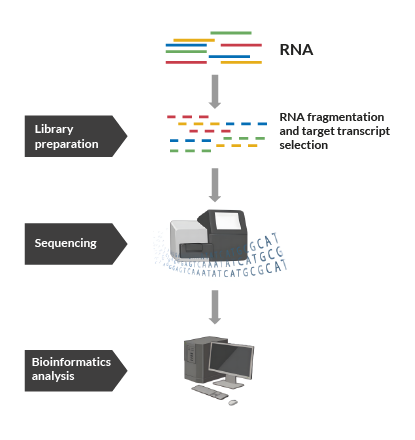
The transcriptome is the set of RNA molecules present in a cellular environment at a given point in time. Most of this RNA originates from the transcription of active genes under specific environmental conditions.
Total RNA-seq transcriptomics quantifies the RNA present in a sample, including messenger RNA, non-coding RNA, and precursor RNA depending on library preparation: poly-A selection (eukaryotes) or ribodepletion (prokaryotes/total RNA). The result is a high-resolution gene expression profile, which we use to perform differential analysis (genes that change between conditions) and enrichment analysis, delivering robust metrics (log2FC, FDR) and interpretable visualisations.
As a complement to microbial community studies, total RNA-seq (or its community-level equivalent, metatranscriptomics) provides the active functional layer whereas metagenomics describes genetic potential (which genes are present), RNA-seq reveals which genes are being expressed and at what level under a specific context (treatments, time, stress). Integrating metagenomics and RNA-seq allows taxonomic profiles to be linked to real functional activity, enabling prioritisation of targets and a deeper understanding of biological mechanisms.
We at Microomics Systems offer a total RNA-seq service tailored to academic and industrial projects that require gene expression quantification in areas such as cell biology, product evaluation, pharmaceuticals, treatments, management practices, human clinical research, and other sectors.
What does our service include?
Scientific and technical consultancy
- Experimental design
- Analysis strategy
- Sampling protocol
- Sample logistics solutions
- Biobanking and sample storage until analysis
- Sample reception and assessment of quality and integrity (RIN/DV200)
Library preparation
- Poly(A) selection, ribodepletion and specialised low-input protocols
- Library quality assessment by capillary electrophoresis
- Illumina NovaSeq 2 × 150 bp sequencing
- A guaranteed 40 million reads per sample (20 million paired-end read pairs), adjustable according to project requirements
Customised bioinformatics analysis
- Quality filtering and validation against the company’s historical project data
- In-house pipelines designed to tailor each analysis
- Differential expression and enrichment analyses
- Two hours of post-delivery analysis included with every complete study
Results delivery meeting
- Interactive reports with dynamic charts and tables
- Materials and methods section
- Downloadable, publication-ready figures based on state-of-the-art standards
More information
View our service datasheets.
Frequently Asked Questions about our RNA-seq Transcriptomics Service
What types of samples can be analysed?
We work with RNA already extracted from tissues, cell cultures, PBMCs, plants, microorganisms, and FFPE samples. We do not include RNA extraction. We require a minimum total input of 1000 ng in a minimum volume of 25 µL at a concentration of 100 ng/µL, with purity (OD260/280) of 2.0-2.2 and ODD260/230 of 2. Whatever the case, we recommend contacting our team to provide details on sample quality and to assess whether a low-input or highly degraded sample protocol is required, for example, in paraffin-embedded samples.
We provide a shipping checklist (RNase-free, dry ice/–80°C storage) and validate feasibility before starting the RNA-seq service.
How do you choose between poly-A or ribodepletion library preparation?
We tailor protocols according to the project type. A commonly used approach for eukaryotes is poly-A selection (mRNA-seq); we apply ribodepletion to prokaryotes or total RNA (removal of rRNA while capturing mRNA, lncRNA, and sRNA). We recommend stranded libraries to preserve transcriptional directionality. We adjust the protocol for low-input samples or if non-coding RNAs need to be captured.
How will I receive the results?
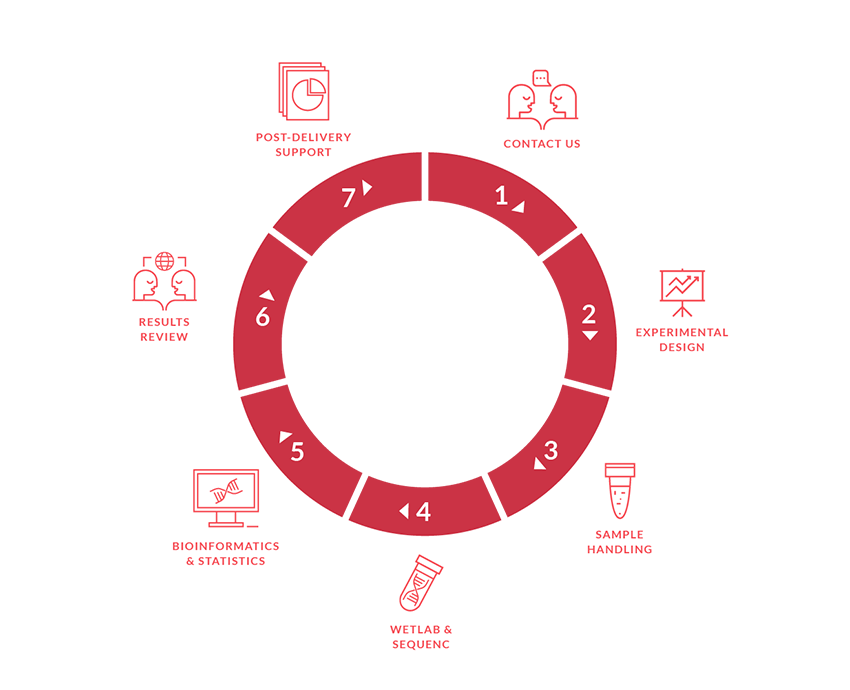
Throughout the process, you will be supported by a Project Manager who will keep you informed of your project’s status. You will have full visibility of your transcriptomics service. Once the analysis has been completed, you will receive a PDF guide together with login credentials to access and download the results from the Microomics server. You will receive the raw sequencing data, a report detailing the materials and methods used in the project, and an HTML report that allows you to explore the results using dynamic tables and graphs, download figures and perform comparisons between analytical models.
How long does the analysis take?
Project turnaround times vary considerably depending on the stages carried out by Microomics (library preparation, sequencing, and bioinformatics analysis) as well as the number and type of samples analysed. Delivery times typically range from 6 to 12 weeks for transcriptomics studies. We recommend contacting our team for a more accurate estimate.
Contact Form
Contact us
Address
C/ Laureà Miró, 408-410
08980, Sant Feliu del Llobregat
Barcelona
Contact
info@microomics.com
Tel: +34 938 874 488
Opening hours
Monday to Thursday: 9:00 AM – 5:00 PM
Friday: 9:00 AM – 3:00 PM